Landscape features predict broad-scale seed rain patterns across fragments of the Brazilian Atlantic Forest
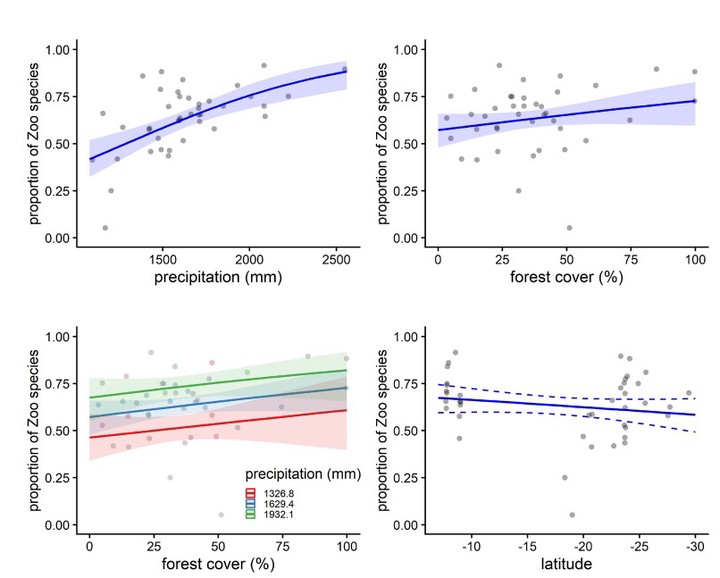 Image credit: Content available from Journal of Ecology
Abstract
The seed rain, that is, the flux of seeds landing on a given location, is a fundamental ecological process driving community assembly and forest regeneration. Because seed rain studies usually focus on a particular site, the influence of landscape features—such as deforestation and fragmentation—on seed dispersal remains poorly understood at the broad scale. We investigated how patch size, forest cover, number of patches, precipitation and latitude influence seed rain parameters (proportion of zoochorous species, seed density, species richness and within-site spatial turnover) spanning a latitudinal gradient from 7° S to 29° S in a highly fragmented global biodiversity hotspot: the Brazilian Atlantic Forest. This is the first study to synthesize seed rain patterns across such a large extent. We compiled a database from 1905 seed traps in 52 study patches. Over 1.3 million seeds were sampled and 1029 taxa were identified to at least the family level. Total precipitation and forest cover were the most important predictors for the proportion of zoochorous species. Seed density increased with the number of patches (fragmentation) for both zoochorous and non-zoochorous species. Species richness and turnover were strongly predicted by forest cover; therefore, increasing with habitat amount, especially in sites with higher precipitation levels. Synthesis. Along with precipitation, forest cover emerges as a fundamental driver of alpha and beta diversity in the seed rain. This highlights the role of habitat amount at the landscape level over patch-level features, like patch size, for seed dispersal. However, increased seed density can be related to higher dispersal rates in forest borders. Understanding these drivers of seed rain can help predict forest regeneration trajectories that shape the future configuration of fragmented landscapes.