Soil microbial communities limit nurse tree seedling performance across forest–grassland gradients
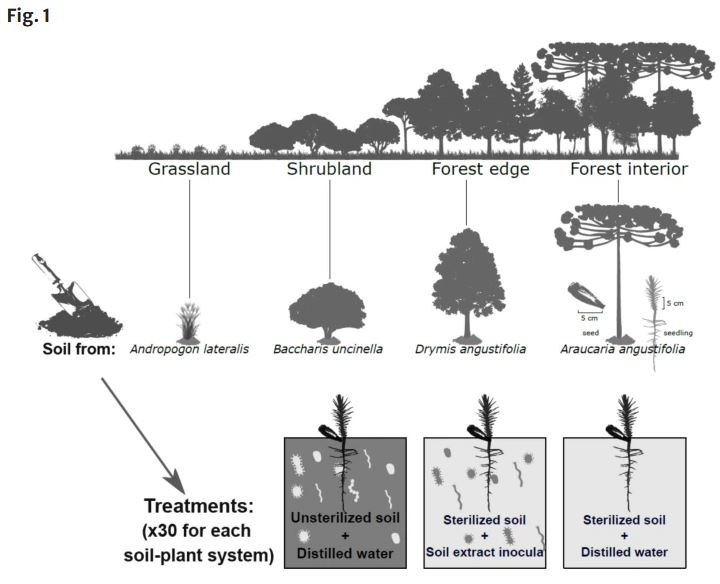 Image credit: Springer - Plant and Soil
Abstract
Seed germination and seedling growth are often limited by extreme abiotic conditions and negative biotic interactions, while facilitation can enhance early plant performance. These positive interactions may be mediated by soil microbial communities (SMC), adding a key component to vegetation dynamics. We evaluated SMC effects from a grassland-forest gradient on the performance of Araucaria angustifolia, a critically endangered tree that acts as a nurse species in forest expansion over grasslands. We expected beneficial effects from SMC associated with adult Araucaria and forest soils. In a microcosm experiment, we tested germination and early growth of A. angustifolia in soils from grassland, shrubland, forest edge, and forest interior. For each soil type, microbial communities were manipulated using three treatments: (1) live soil with intact microbiota (unsterilized), (2) sterile soil with microbial communities removed (autoclaved), and (3) inoculated soil, where a microbial wash was reintroduced into sterile soil.Contrary to our expectations, SMC from all soil types had neutral effects on germination but negative effects on seedling performance. These net negative effects were consistent across the grassland-forest gradient. Seedling growth was lowest in forest interior soils, where adult Araucaria trees are abundant and highest in sterilized soils. Overall, SMC reduced A. angustifolia seedling performance. While this may favour the persistence of grasslands, it also suggests that the slow pace of forest expansion over grasslands may be mediated by belowground biotic interactions. Our results highlight the importance of SMC in shaping vegetation dynamics and succession in subtropical highland ecosystems.

Rafael Barbizan Sühs
Postdoctoral fellow
I am focused on understading processes and patterns of vegetation ecology and dynamics.